
2020: Year in Review — COVID-19 Impacts on Toronto Real Estate
Any conversation about how Toronto’s real estate market reacted to the beginning of the Coronavirus pandemic in 2020 needs to begin with how the market was performing before pandemic-instigated lockdowns were presented in mid-Walk.
As we gave generally little consideration to the reports of another Covid emerging from China and affecting Italy in mid 2020, the main quarter of 2020 in Toronto land had overall similar indications of the blast seasons of speculative and unreasonable craze we saw quite a while before all through the More prominent Toronto Zone (GTA).
It was commonplace for houses to get 20 to 30 proposals on their offer evening and to sell for essentially above market esteem.
Here are a portion of the media features portraying the market around then:
RBC fears Toronto’s real estate market is set out toward another round of foam
FOMO has gotten back to the Toronto real estate market
Is Toronto’s real estate market set out toward a rehash of 2017? An inventory deficit is pushing house costs north, once more
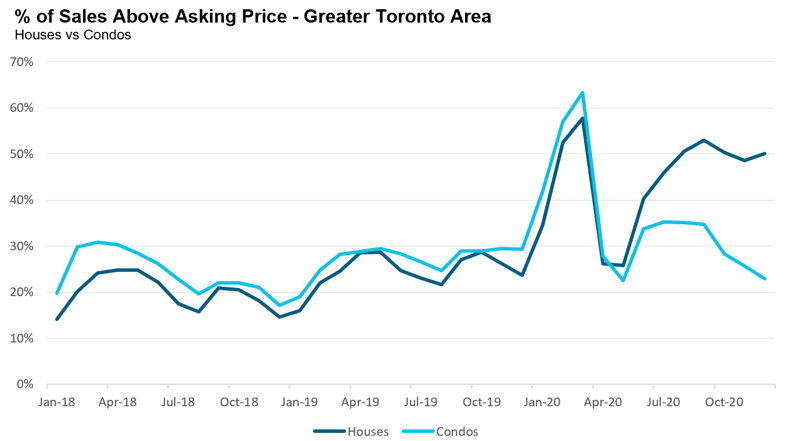
The most ideal approach to see this flood in richness is by taking a gander at the % of homes that were selling for over the dealer’s asking cost. In 2018 and 2019, between 15-30% of houses and apartment suites were selling for over the proprietor’s asking cost. At that point, in February and Walk of 2020, 50-60% of houses and townhouses were selling for more than the vender’s asking cost. Normal costs were up 17% and 15% in February and Walk individually.
And afterward came Coronavirus.
The Onset of Covid-19: First Lockdown in March
While the Province of Ontario went into a lockdown in mid-March, shutting down activity in the downtown core as office workers began to work from home and all residents were urged to stay at home as much as possible, we didn’t see the resulting impact on the real estate market until April when sales plummeted 67%; in May, sales were down 54%.
The market had, in effect, frozen. Few buyers were going out to look at houses and sellers had a very hard time selling their homes.
The COVID Forecasts
By May, most big banks and housing analysts had released their forecasts for Toronto’s housing market in light of the COVID-19 lockdowns and recession that was expected to follow. Most forecasts were expecting house prices to remain relatively flat or see a slight single digit decline. The Toronto Dominion (TD) Bank forecast of an 8% increase in house prices during the pandemic was the most optimistic.
The most pessimistic forecast came from Canada’s housing regulator, the Canadian Mortgage and Housing Corporation (CMHC), which predicted that house prices would fall by 9 to 18% from their pre-COVID-19 level.
The Bounce Back
When my partners and I chose to react to the stressed inquiries of land purchasers by facilitating a free, online summit in July to hear the perspectives on top financial specialists, lodging experts, and professionals on where things may be going, the market had effectively started to bob back surprisingly rapidly. Purchasers reappeared the market in June, bringing about that month seeing just a 2% decrease in deals contrasted with the earlier year.
Then, the market for houses (barring apartment suites) got back to the excited speed we saw during the principal quarter of 2020. By August, deals were up 40% over the earlier year and over half of houses were selling for more than their asking cost.
This abrupt bounce back got most business analysts and the land business unsuspecting. There was as yet a lot of monetary vulnerability, Canada’s joblessness rate was as yet in twofold digits and a huge number of Canadians were conceding their home loan installments. This kind of financial climate Is commonly not joined by a blast in the real estate market.
Thinking back, obviously the bounce back was driven by three principle factors.
Initially, when we take a gander at the change in business rates by hourly wage we see that this downturn lopsidedly affected lower pay workers versus higher pay procuring family units. By far most of purchasers who hit stop on their home pursuit in April never lost their employment or saw their wages decay, they just began telecommuting.
The second factor behind the flood in deals was repressed interest. As indicated over, Toronto’s real estate market was inconceivably serious in the principal quarter of 2020 with request far outperforming the stockpile of houses accessible. The purchasers that hit stop in the second quarter with the beginning of Coronavirus limitations didn’t vanish — they were simply hanging tight for the correct second to re-start their home inquiry. The bustling spring selling market was deferred for a very long time, bringing about swelled home deals in the late spring which made year-over-year examinations somewhat deceptive.
The third factor driving the bounce back was a move in what property holders need in a home. Telecommuting drove numerous mortgage holders to esteem houses that had sufficient space for home workplaces, more space for youngsters to play in and greater terraces.
This shift in preferences resulted in new buyers entering the market who were not looking to buy a home prior to COVID-19. This “urban exodus” saw many households sell their smaller downtown houses in favour of larger detached homes in the outer suburbs or beyond.
This shift in buying behaviour had a bigger impact on the outer suburban markets where they were buying vs. the downtown markets they were selling in since there are relatively fewer sales in many of the outer suburban areas so even a slight increase in demand can overheat those markets.
Decline In Rents
Given that this recession had a disproportionate negative impact on lower income earners, it’s no surprise that the rental market was hit much harder than the resale market.
By October, there were over 12,000 condominium units available for lease in the GTA — more than 3 times the number of units available the year before. In my October 2020 report, I looked at the key factors driving this surge in rental inventory and the number one factor was tenants simply moving out of their units.
In some cases, they moved because of lost jobs or income which reduced their ability to pay rent; however, in other cases, they moved back home with family due to other COVID-19 impacts. Pre-COVID, a downtown condo offered its renter a short walk to their office or school and a vibrant culture and nightlife.
After the onset of COVID, a 500 sq. ft. condo suddenly felt a bit too small to live and work in at all hours. The absence of the need to commute to work or school as such activities moved online and the city lifestyle that previously made up for the lack of space added to this push, as did concerns about the risks of COVID transmission in shared spaces like elevators and public lobbies, and in the case of those sharing with roommates, kitchens and other sharing living spaces within units.
Others sought also to mitigate the negative effects of isolating alone in lockdown as opposed to living with family. As a direct impact of COVID-19, average condo rents in the old City of Toronto (downtown) fell by a remarkable 19% by December and 10% in the GTA, something that could hardly be imagined prior to the pandemic, when high demand and high rents characterized the rental market.
Condo Market Rebound
While demand for low-rise houses in the GTA surged in the second half of 2020, the downtown condo market in Toronto was sluggish. Inventory surged and prices fell by roughly 10% from their peak during the first quarter of 2020.
Downtown condo apartments were slow to sell with many units getting only 2 to 3 showings a week, a stunning turnaround for what was the hottest segment of the market only months earlier.
In November, our sales team at Realosophy Realty noticed a sudden surge in interest from condo investors who were eager to capitalize on the recent price declines in downtown condos. This resulted in a surge in condo sales in December (up 75%) and Months of Inventory (MOI) levels tightening from 2.9 in November to 1.7 MOI in December.
This surge in investor demand is interesting given that the rental market remains sluggish and rents remain down. But investors tend to be an optimistic bunch and they believe that the rental market, and rents, will be back to normal in no time and that condo prices will also rebound in 2021, so they are motivated to buy for less now while they can.
The Mortgage Deferral-Cliff Has Come and Gone
As part of the response to the unprecedented economic shutdown necessitated by the onset of COVID-19 in March, banks allowed homeowners who were negatively impacted financially to defer their mortgage payments for up to six months. By the end of May, 12% of all mortgages were in deferral and CMHC predicted that this number could reach as high as 20% by September.
By October/November, the hundreds of thousands of households that deferred their mortgage payments for six months would have to start re-making payments again, resulting in what has been termed a “deferral-cliff”. The concern in the summer months was whether households would be able to start making their payments again or whether banks would need to starting working with financially distressed households, unable to hang onto their homes.
But by the end of the year, it looked like the deferral cliff wasn’t much of a cliff after all. The big banks reported that the vast majority of households that were deferring their mortgage payments were back on track with their payments after the deferral period ended.
It turned out that some households deferred their mortgage payments as a precaution due to the fear of — rather than the actual experience of — financial hardship.
Read my full analysis on this and other key trends in the January 2021 Move Smartly Report
SEE OUR
FEATURED LISTINGS